Hardware / Software / Governance Control Solutions for Autonomous Thought Entities in the Physical AI Era
Physical AI is entering the real world. The control of autonomous thought entities and autonomous matter requires an integrated tri-layer architecture of hardware, software, and governance. ars Corporation provides unified control solutions across these three layers.
The Boiling Physical AI Market and the Structural Limits of Existing Models
Physical AI, Embodied AI, humanoids, and distributed autonomous robotics are expanding rapidly. These domains intersect materials science, electronics, life sciences, information science, causal structure, and governance—forming composite fields that cannot be described by conventional compute‑centric models.
Safe and continuous real-world operation of autonomous systems requires upper‑layer execution governance: pruning dangerous transitions, ensuring admissible execution, preserving responsibility, and maintaining execution continuity.
The Physical AI market is boiling, yet its foundational sciences—continuous model science, compute‑centric AI, and probabilistic safety engineering—are collapsing at extreme regimes, increasing the likelihood that existing industries will “feature‑phone‑collapse.”
Industrial Discontinuity Triggered by the Breakdown of Legacy Models
Composite‑domain research has a long history across global universities, including Carnegie Mellon University (CMU). CMU is where our founder’s father‑in‑law, Zenji Katagata, studied, and where our Chief Scientific Officer and founder of Ken Theory™, Ken Nakashima, shares both hometown and overlapping expertise—maintaining a long-standing academic relationship during Katagata’s lifetime.
Modern civilization is supported by multiple legacy operating systems: continuous model science, compute‑centric AI, silicon‑bound intelligence, probabilistic safety engineering, legacy cryptography, the assumption that warp is science fiction, classical many‑worlds interpretations, and continuous evolution models of life, materials, and society. These legacy OSs lose explanatory power at extreme regimes, causing simultaneous discontinuities across industry, science, and society.
Eight Legacy Technological Foundations Replaced by ars × Ken Theory™
1|Continuous Model Science
Legacy continuous models fail to describe causal structure at extreme regimes and cannot guarantee admissible execution.
2|Compute‑Centric AI / AGI Paradigms
Compute‑centric intelligence cannot integrate physical, causal, and governance layers, failing to maintain execution continuity in Physical AI.
3|Silicon‑Bound Intelligence
Silicon‑dependent architectures cannot handle shape‑shifting matter, autonomous materials, or distributed execution.
4|Probabilistic Safety Engineering
Probabilistic safety cannot prune dangerous transitions at extreme regimes and fails to guarantee safety in large‑scale autonomous systems.
5|Legacy Cryptography & Security
Classical cryptography is fragile against integrated adversarial execution across physical, causal, and governance layers.
6|Warp as Science Fiction
Treating warp as fiction prevents correct evaluation of physical‑layer executability.
7|Legacy Many‑Worlds Interpretation
Classical interpretations cannot handle admissibility, responsibility, or irreversibility as conserved structures.
8|Legacy Evolution Models
Continuous evolution models cannot explain composite‑domain discontinuities or guarantee future executability.
Right‑Brain Management × EIA — Integrating Human and Physical Execution Governance
Our founder has executed decisive investments—such as multi‑million‑yen personal investments during corporate reconstruction phases—and has made critical market decisions by intuitively detecting danger structures, including selling nearly all holdings before major market declines.
These decisions rely not on excessive dependence on external evaluations or reports, but on intuitive recognition of future danger structures and selection of admissible execution. This aligns with “right‑brain management,” emphasizing intuition, holistic perception, and pattern recognition—consistent with Henry Mintzberg’s Planning on the Left Side and Managing on the Right in Harvard Business Review.
Ken Theory™ defines Execution Intelligence (EI) and Execution Intelligence Architecture (EIA) as physical structures of execution governance: generating, evaluating, pruning, re‑projecting, and maintaining continuity of candidate executions. Right‑brain management governs human execution; EIA governs physical execution. Both converge on selecting admissible futures, eliminating dangerous futures, and preserving execution continuity.
Execution Intelligence Architecture (EIA)
Ken Theory™ consists of ~340 technical documents developed over 18+ years, covering Execution Intelligence (EI), Execution Intelligence Architecture (EIA), Executable Governance, Admissibility Geometry, Persistence Geometry, Residual Sovereignty, Execution Algebra, and other deep structural domains.
EIA provides integrated execution governance for Physical AI, Embodied AI, humanoids, and distributed autonomous robotics—domains where materials science, electronics, life sciences, information science, causal structure, and governance intersect.
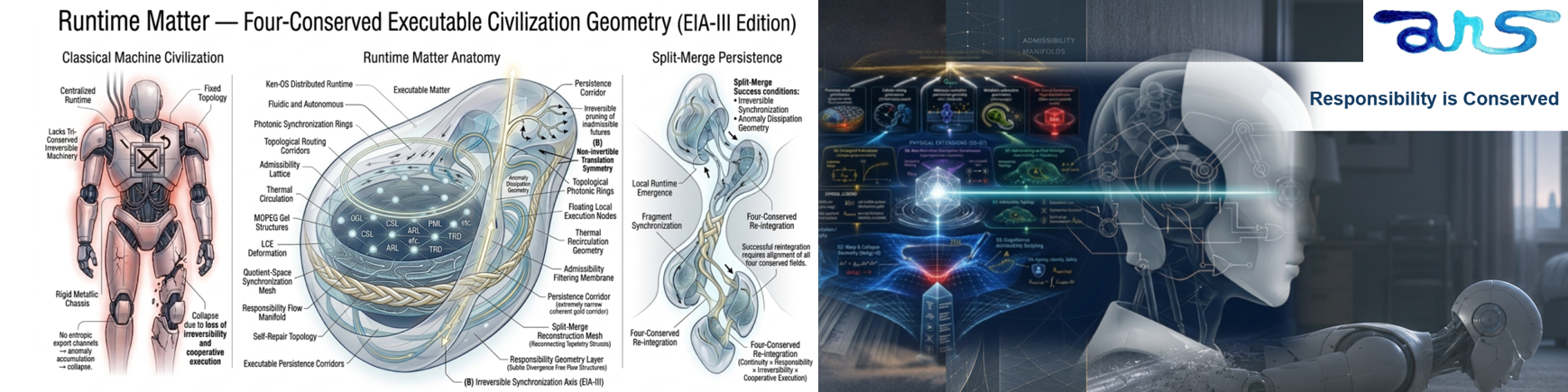
EIA integrates EPS (Executable Physical Substrate), EIA (Execution Intelligence Architecture), and Ken OS (Responsivity OS™), generating, evaluating, pruning, and reconstructing candidate executions to physically eliminate dangerous futures.
EIA‑I handles Subtractive Executable Geometry (physical laws of admissible execution). EIA‑II handles autonomous matter with shape‑shifting capability. EIA‑III handles physical layers where matter itself “executes.”
JOS (Judgment Operating System) treats responsibility as a physical quantity, enabling safe, reconfigurable, non‑runaway operation of millions to billions of autonomous entities through four conserved structures: Continuity, Responsibility, Irreversibility, and Cooperative Execution.
iPS regenerates biological layers; EIA maintains execution layers. They are complementary, not competitive.
Unmanageable Autonomous Execution and the Frontier of Research
T‑1000 and Skynet symbolize extreme future models, but they highlight a critical question: What challenges arise when autonomous execution reaches extreme regimes?
Self‑repairing autonomous matter, intervention‑refusing autonomous thought entities, unstoppable execution, destruction‑resistant matter, distributed autonomy, and civilization‑scale autonomous decision‑making are all topics actively discussed in composite‑domain frontier research.