Executive Profile
Our President has a proven record of making decisive personal investments of several tens of millions of yen in companies undergoing business reconstruction. Investment outcomes are inherently divided between success and failure; when successful, the decision is judged correct, and when unsuccessful, it is judged incorrect.
Even after thoroughly reviewing external evaluations and various investigative reports, our representative has demonstrated the ability to make independent decisions without being overly influenced by such information. These decisions rely not on excessive dependence on external evaluations or reports, but on intuitive recognition of future danger structures and selection of admissible execution. This decisiveness is also reflected in the decision to collaborate with Ken Theory™.
In earlier years, our representative engaged in substantial stock investments and detected market danger signals, selling nearly all holdings before a major market decline occurred. This experience remains a significant part of his decision-making history.
The Concept of “Right-Brain Management” in Business Administration
In the field of business administration, decision-making styles that emphasize intuition, holistic perception, and pattern recognition are sometimes described metaphorically as “right-brain management.” This term is not used in a neuroscientific sense but as a conceptual metaphor within management studies.
Henry Mintzberg’s Planning on the Left Side and Managing on the Right in the Harvard Business Review highlights management styles that value not only analytical reasoning but also broad situational awareness and conceptual thinking. Research in management and cognitive science, both domestically and internationally, reports that expert intuition—formed through extensive experience—is effective for rapid decision-making under high uncertainty.
Intuition is not a mysterious ability but is understood as high-speed pattern recognition shaped through years of experience. Our representative’s decision-making style aligns with this “experience-based intuition,” and this alignment is reflected in decisions made in new business development and uncertain environments.
Positioning of Intuition within EI/EIA
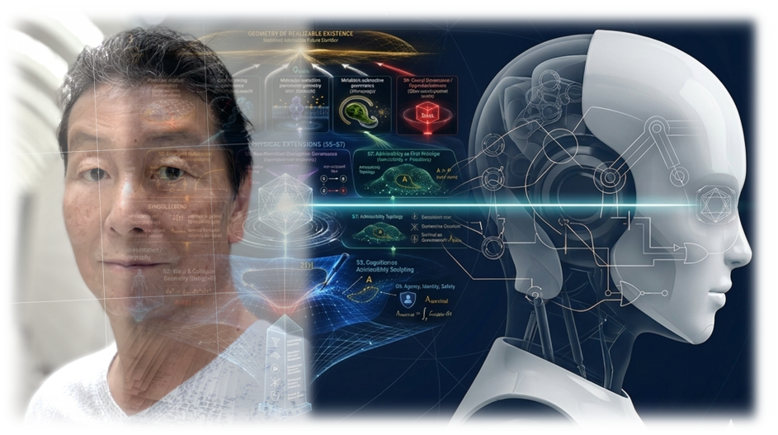
Ken Theory™ and its associated patent filings define EI (Execution Intelligence) and EIA (Execution Intelligence Architecture) not as mere intuition or inspiration, but as structured processes of execution governance:
- Generating numerous candidate executions
- Evaluating admissibility on the runtime
- Pruning dangerous candidates (Collapse Filtering)
- Re-projecting toward admissible futures
- Maintaining executable continuity
This structure differs from the traditional notion of intuition as an “unexplainable ability,” instead describing it as a governance process over candidate executions.
The “high-speed pattern recognition” described in management studies explains part of EI, but does not address the deeper internal structures of candidate generation, evaluation, pruning, and reconstruction. This is where both fields intersect.
In future corporate publications and white papers, the following positioning becomes possible: Traditional management theory explains expert intuition as “experience-based high-speed pattern recognition,” whereas EI describes intuition as “a runtime process that governs candidate executions, prunes dangerous futures, and selects admissible futures.”
In ongoing patent filings, the protected subject is not human intuition itself, but the machine-implementable runtime governance that generates, evaluates, prunes, and reconstructs candidate executions. This approach translates the decision-making processes of experienced individuals into an engineering and implementable framework.
If this bridge is established, fields such as management, AI, robotics, and intelligent operating systems may be discussed through the shared lens of “execution governance.” This does not imply endorsement of EI by any specific university or institution, but rather indicates that existing intuition research and EI/EIA theory can be organized in a complementary academic relationship.
Global Mission — The −5°C Real‑World Temperature State Initiative
Our President has commissioned our CSO, Ken Nakashima, to execute a corporate‑driven program based on Ken Theory™ aimed at forming a real‑world temperature state at least 5°C below the corresponding non‑intervention environment. The technical solution required for this objective has already been identified, and preparations for patent filing are underway. The program is now transitioning from conceptual validation to practical execution.
To enable controlled physical verification in real‑world conditions, the company is currently preparing the establishment of an appropriately scaled and suitably conditioned experimental field. Once secured, this field will serve as the initial site for implementing and verifying the formation, persistence, and recoverability of the required temperature state. (Specific details regarding the site are confidential.)
The −5°C criterion was originally specified by the corporate side as a quantitative requirement for real‑world impact. The initiative does not rely on a single cooling method or isolated control variable; instead, it evaluates and utilizes the full set of physical degrees of freedom—including heat, radiation, fluids, matter, materials, phases, interfaces, gravity, surface and subsurface systems, water systems, and Earth–space environmental interactions. This program reflects our corporate commitment to addressing planetary‑scale challenges through admissible execution and structured state formation.
For the detailed technical formulation of this initiative, please refer to the dedicated research page: Research Theme — Formation, Persistence, Recoverability, and Continuity of a −5°C Real‑World Temperature State
Aperitif Cultural Activities — 33 Years of Continuity
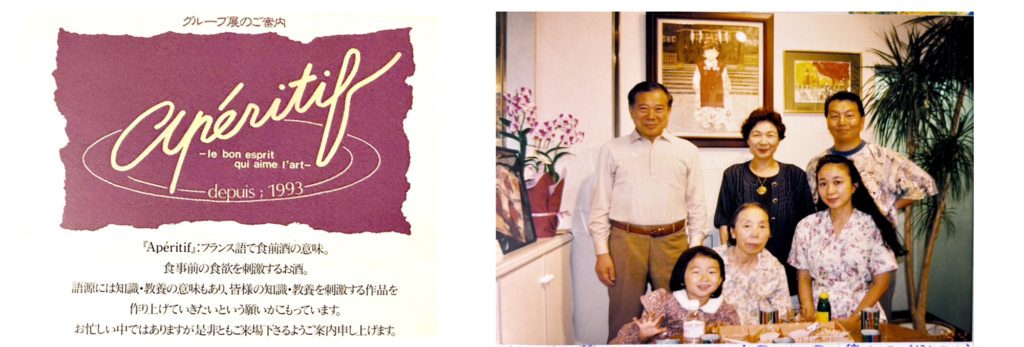
Since 1993, our representative has hosted the cultural group exhibition Aperitif in Harajuku. The exhibition has been held annually for one week, and the 34th exhibition is scheduled for 2027. The first exhibition featured 18 participants and attracted over 200 visitors. Works included watercolor, oil painting, ceramics, photography, and other diverse media. The exhibition is recognized as a cultural activity that has continued for 33 years.
At the exhibition held on July 10, 1994, our representative’s father-in-law, the late Professor Zenji Katagata—an accomplished scholar in telecommunications, systems engineering, and information culture—participated. A photograph documenting the event remains, showing Professor Katagata (top-left) and our representative (top-right).
Executive Leadership — Personal Anecdote
Our President has a side that is not widely known to the public, yet those close to him are all familiar with it.
His wife — the daughter of Professor Zenji Katagata — passed away at a very young age. In most cases, when such a tragedy occurs, the relationship with one’s father‑in‑law naturally fades. Many people lose emotional capacity, and distance inevitably grows.
But President Abe was different.
Even after his wife passed away, and even as Professor Katagata grew older, President Abe continued to visit and support him with unwavering dedication. Whenever Professor Katagata fell ill, President Abe was always the first to rush to his side, offering support and care.
I accompanied him many times during those moments, and I can attest that every part of this account is true. President Abe has quietly demonstrated deep respect and sincerity toward his father‑in‑law through consistent actions over many years.
— This account is written by Ken Nakashima, a close associate of President Abe, based on firsthand experience.
Executive Leadership — Personal Anecdote
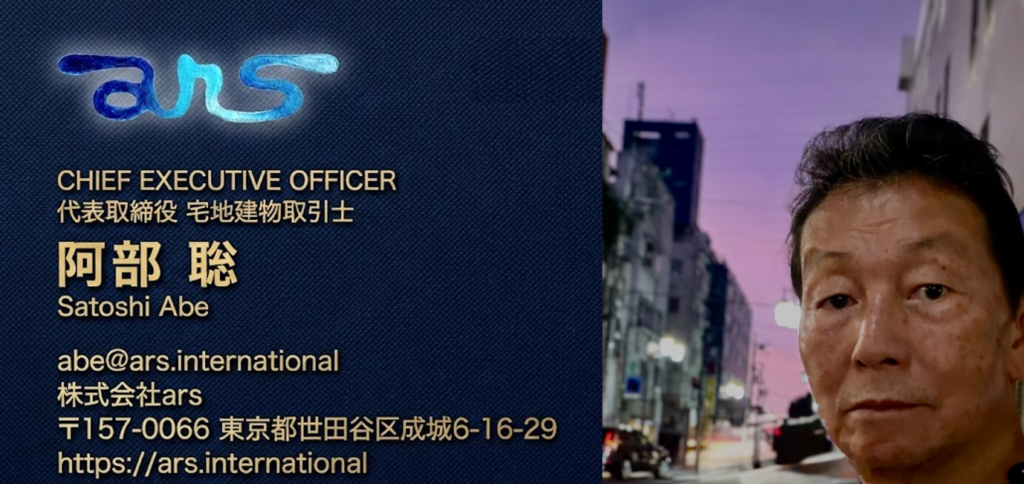
A Message from President Satoshi Abe
Written on August 1, 2026 — three days after reaching Koki (age 70)
On July 29, 2026, I reached the age of seventy. Three days later, at 6:57 PM on August 1, I was walking near Seijo‑Gakuenmae Station, close to my home. When I looked up at the sky, I saw a purple glow unlike anything I had ever witnessed.
It was quiet, deep, and carried a kind of blessing. It felt as though the sky itself was celebrating my seventieth birthday. I instinctively raised my phone and captured the moment.
The scene felt like a frame from a film. It was a special sight—one that I encountered precisely because I live in Seijo, a place where I often cross paths with notable figures and take photographs. Yet this single image of the purple sky became one of my most memorable “best shots.”
For me, this purple sky quietly signaled the beginning of the final chapter of my life.
— Satoshi Abe, President & CEO, ars Inc.