Overview
Ken Theory™, handled by ars Corporation, consists of approximately 340 technical documents developed over more than 18 years of research. These documents span multiple deep structural domains, including Execution Intelligence (EI), Execution Intelligence Architecture (EIA), Executable Governance, Admissibility Geometry, Persistence Geometry, Residual Sovereignty, and Execution Algebra.
Among these, Execution Intelligence Architecture (EIA) is a unified physical‑layer governance framework designed for rapidly expanding composite domains such as Physical AI, Embodied AI, humanoids, and distributed autonomous robotics.
1. Global Technological Trends and the Need for EIA
Physical AI, Embodied AI, humanoids, and distributed autonomous robotics intersect materials science, electronics, life sciences, information science, causal structure, and governance. These composite domains cannot be described by conventional compute‑centric models.
Safe real‑world operation of autonomous systems requires upper‑layer execution governance:
- Pruning dangerous transitions
- Ensuring admissibility
- Preserving responsibility
- Maintaining execution continuity
EIA is built as a unified physical‑layer framework to govern these execution processes.
2. Structure of EIA (EPS × EIA × Ken OS)
EIA sits at the center of Ken Theory’s execution‑intelligence system and operates in coordination with three structural layers:
● EPS (Executable Physical Substrate)
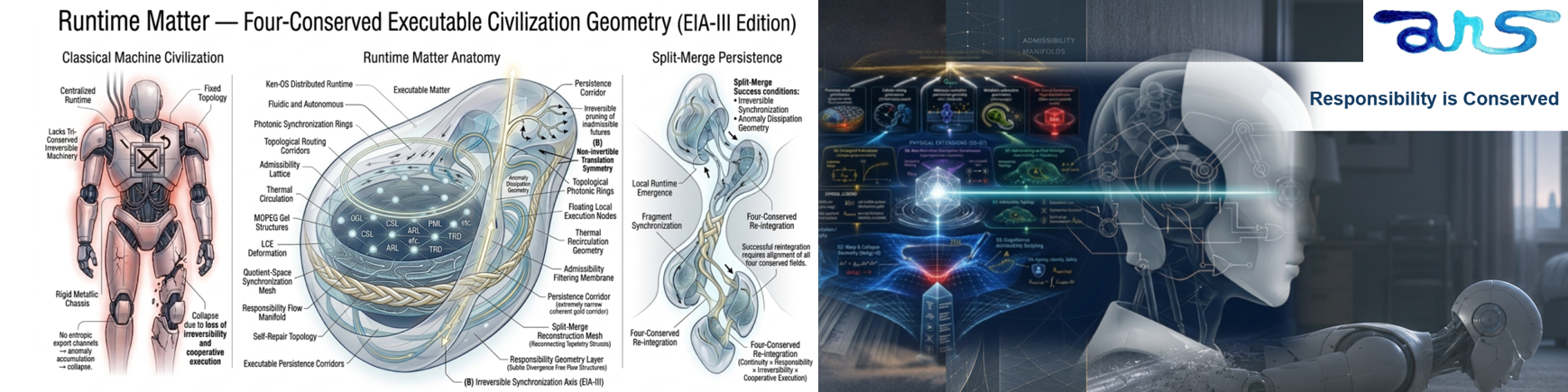
The physical layer behaves as executable geometry, handling shape‑shifting, splitting, merging, flowing, self‑repair, irreversible synchronization, and cooperative execution as physical phenomena.
● EIA (Execution Intelligence Architecture)
The governance layer of execution. It generates, evaluates, prunes, and reconstructs candidate executions, physically eliminating dangerous futures.
● Ken OS (Responsivity OS™)
The upper execution layer handling continuity, causal structure, and responsibility potential.
3. Summary of EIA‑I / EIA‑II / EIA‑III
Ken Theory™ organizes EIA into three major components:
◆ EIA‑I: Subtractive Executable Geometry
Describes physical laws of admissible execution across optics, spintronics, crystals, and biological structures. Includes:
- Subtractive Admissibility Geometry
- Nakashima Circuit™, NLGB, NLQ
- Foundations of Executable Reality
◆ EIA‑II: Autonomous Matter with Shape‑Shifting Capability
Integrates:
- MOPEG phase‑change materials
- LCE multi‑stage actuation
- Topological communication
- Non‑Hermitian dissipation
- Topology‑preserving energy circulation
These enable splitting, flowing, merging, self‑repair, functional updating, and shielded communication under a unified protocol.
Physical safety guarantees:
- ARL (Advance Risk Limitation)
- Admissibility field
◆ EIA‑III: Executable Matter Physics
Defines a physical layer where matter itself executes. Execution geometry is shaped by interfaces, soft matter, electron density, and defect curvature. Admissibility and responsibility unify as a bidirectional spacetime structure, forming the basis of Executable Civilization.
4. JOS (Judgment Operating System)
JOS treats responsibility as a physical quantity, governing:
- Responsibility flow
- Responsibility horizon
- Responsibility thermodynamics
- Non‑dissipative propagation of responsibility potential
Together with EIA’s execution geometry, JOS realizes the Continuity × Responsibility dual conservation law.
5. Four Conserved Structures
EIA’s deep structure is unified by four conserved quantities:
- Continuity
- Responsibility
- Irreversibility
- Cooperative Execution
These enable safe, reconfigurable, non‑runaway operation of large‑scale autonomous systems ranging from millions to billions of entities.
6. Relationship with iPS
iPS handles regeneration of biological layers. EIA handles continuity of execution layers. They are complementary, supporting human survival structures across multiple layers.
7. Further Information
For more details, please refer to the official Ken Theory™ documentation on Execution Intelligence Architecture.