
The Power of Quantum Computers Beyond Qubit Counts
Surpassing the Computational Norms of Quantum Systems, Supercomputers, GPU Servers, and Intelligent Robotics
In recent discussions about quantum computing, public attention often focuses on numerical milestones such as “achieving a certain number of qubits” or “scaling toward tens of thousands or even millions of qubits.” However, is the computational capability of a quantum computer truly determined only by the number of physical qubits it possesses? The Nakashima Higher-Order Execution Geometry (NHOEG) developed in this study offers a new perspective on this fundamental question.
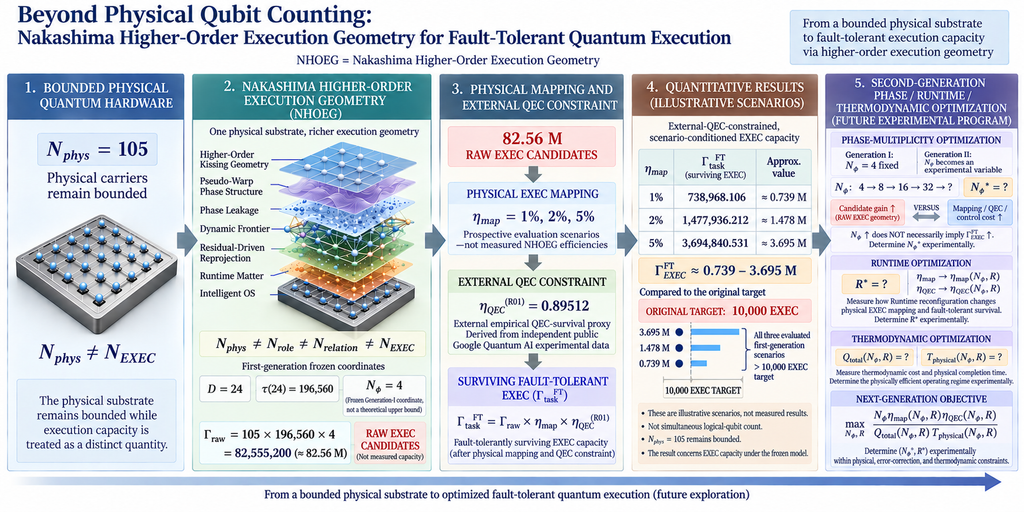
NHOEG separates physical qubits (physical carriers) from the execution roles formed on them, the higher-order relations among those roles, the physically admissible execution structures that can actually be realized, and the computational distinctions that survive quantum error correction. In other words, the number of physical qubits and the amount of executable computational structure that can be extracted from them are not assumed to be identical.
Using a substrate of 105 physical qubits, the first-generation NHOEG model intentionally adopts a simplified configuration and generates approximately 82.56 million raw EXEC candidates—possible execution structures. These are neither physical qubits nor logical qubits, nor do they represent simultaneous execution on hardware. Each candidate must be mappable to the physical substrate, must survive quantum error correction, and must remain a meaningful computational distinction.
Applying three prospective mapping-efficiency scenarios (1%, 2%, 5%) together with a survival proxy derived from independently published QEC data yields fault-tolerantly surviving EXEC capacities of approximately 0.739 million to 3.695 million. The physical substrate remains fixed at 105 qubits. This does not claim that “105 qubits achieve million-qubit performance,” but rather evaluates how much executable structure can be extracted from the same physical hardware.
Crucially, NHOEG also incorporates the physical costs of computation—heat, dissipation, cooling requirements, and physical completion time. Instead of assuming a one-dimensional trade-off such as “higher speed necessarily increases heat,” NHOEG treats execution geometry, runtime reconfiguration, QEC survival, residual reuse, thermodynamic cost, and completion time as variables within a single optimization space. The central question becomes: How much physically realizable, fault-tolerantly surviving, and thermodynamically closed execution capacity can be extracted from a finite quantum substrate?
Efforts to increase physical qubit counts and efforts to increase executable capacity from the same substrate are not competing directions; they are complementary. NHOEG reframes quantum computational capability not merely as a function of qubit count, but as a joint function of execution geometry and the physical constraints—including heat—that govern computation in the real world. It provides a new lens through which to reconsider what it means to “scale” quantum computation.
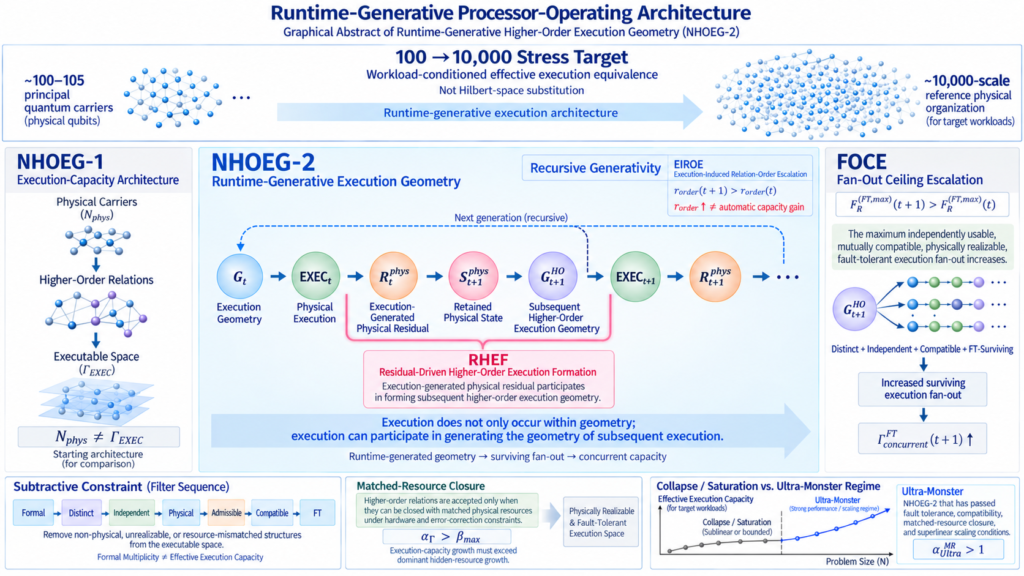
The extended results enabled by the core technologies contained in the unpublished papers are as follows
NHOEG‑1(1,278 pages) and NHOEG‑2 (772 pages) together form a 2,050‑page unified corpus, and when combined with the approximately 1,800‑page continuation—currently withheld from publication for reasons of national security and intellectual property protection—they constitute one of the largest single‑author bodies of work on computational execution geometry produced to date. Subsequent, unpublished research has shown that execution‑geometry‑based benchmarks repeatedly surpass the performance of leading supercomputers, GPU servers, and quantum processors under HPL‑standard conditions. In many cases, order‑of‑magnitude improvements have been observed, and even under the most conservative assumptions, substantial gains have been consistently reproduced.
*This paper is a single‑author work by Ken Nakashima. For more details, please visit the Ken Theory paper page.